Every Time Travel Movie Has the Same Fatal Flaw Nobody Talks About

The TARDIS dematerialises. It rematerialises — somewhere. Not in the London of 1963. In empty space, roughly 40 million kilometres from where Earth happens to be that November. The Doctor has approximately four minutes of oxygen and a very confused sonic screwdriver.
This is the flaw every time travel story ignores. Here’s why.
The Problem With Standing Still
Here’s what those stories get wrong. Every point in the universe can be described by where it sits in space and when it exists in time. The implicit assumption in every static time machine — the TARDIS1, the DeLorean2, H.G. Wells’ chair3 — is that you can change the when while the where stays constant. Step in, travel back thirty years, step out onto the same street.
But the street was never at these coordinates thirty years ago. Earth is never at the same position twice. It orbits the Sun. The Sun orbits the galaxy. The galaxy moves through space. The universe has never, not once, held still.
How Fast Is “Standing Still”?
Let’s run the numbers, because they are spectacular.
- Earth orbits the Sun at roughly 30 km/s4. Travel back one year and Earth has lapped its entire orbit — you’re nearly a billion kilometres off.
- The Sun orbits the galactic centre at roughly 230 km/s5. Go back a decade and the Sun — along with everything on it — has moved about 73 billion kilometres along its arc.
- The Milky Way itself moves at around 600 km/s relative to the cosmic microwave background6.
As Caleb Scharf calculated in Scientific American, a single month of time travel already requires accounting for approximately 78 million kilometres of orbital displacement alone — “correct to within a part in a trillion.”7
Go back a century and you don’t materialise in 1926 London. You materialise in a patch of interstellar space where London will not be for another hundred years. Go back to the dinosaurs and you’d need a very good star chart and a lot of fuel.
The TARDIS would need wings. Real wings.
The Precision Problem
If the universe is moving that fast, the natural question is: how precisely would a time traveller need to hit their temporal target?
Start with Earth’s orbital velocity alone — 30 km/s. A timing error of just 1 millisecond means Earth has moved 30 metres from the calculated position. That’s roughly the length of three buses. You’d materialise inside a wall, or more poetically, halfway through someone’s Tudor cottage.
The Sun’s galactic motion and the Milky Way’s own drift through space add further displacement in directions that shift with the geometry of the moment. Sometimes they partially cancel. Sometimes they compound. Either way, you’re not in control of which. Thirty metres per millisecond — Earth’s orbital contribution alone — is the floor. The ceiling is undefined.
Now run it in reverse: what temporal precision is required to arrive within 1 millimetre of your target?
| Velocity component | Speed | Required precision for 1mm |
|---|---|---|
| Earth’s orbit | 30 km/s | 33.6 nanoseconds |
| Sun’s galactic motion | 230 km/s | 4.4 nanoseconds |
| Galaxy’s peculiar motion | 600 km/s | 1.7 nanoseconds |
Sub-nanosecond precision. For a journey measured in years, decades, or millennia. Each row in that table is a minimum — the other velocities add unpredictably on top, depending on direction.
For context: GPS satellites maintain nanosecond-level clock synchronisation8 — and even with that precision, position errors creep in from atmospheric interference, satellite geometry, and signal bounce. Time travel navigation would demand the same clock precision, across a vastly harder problem.
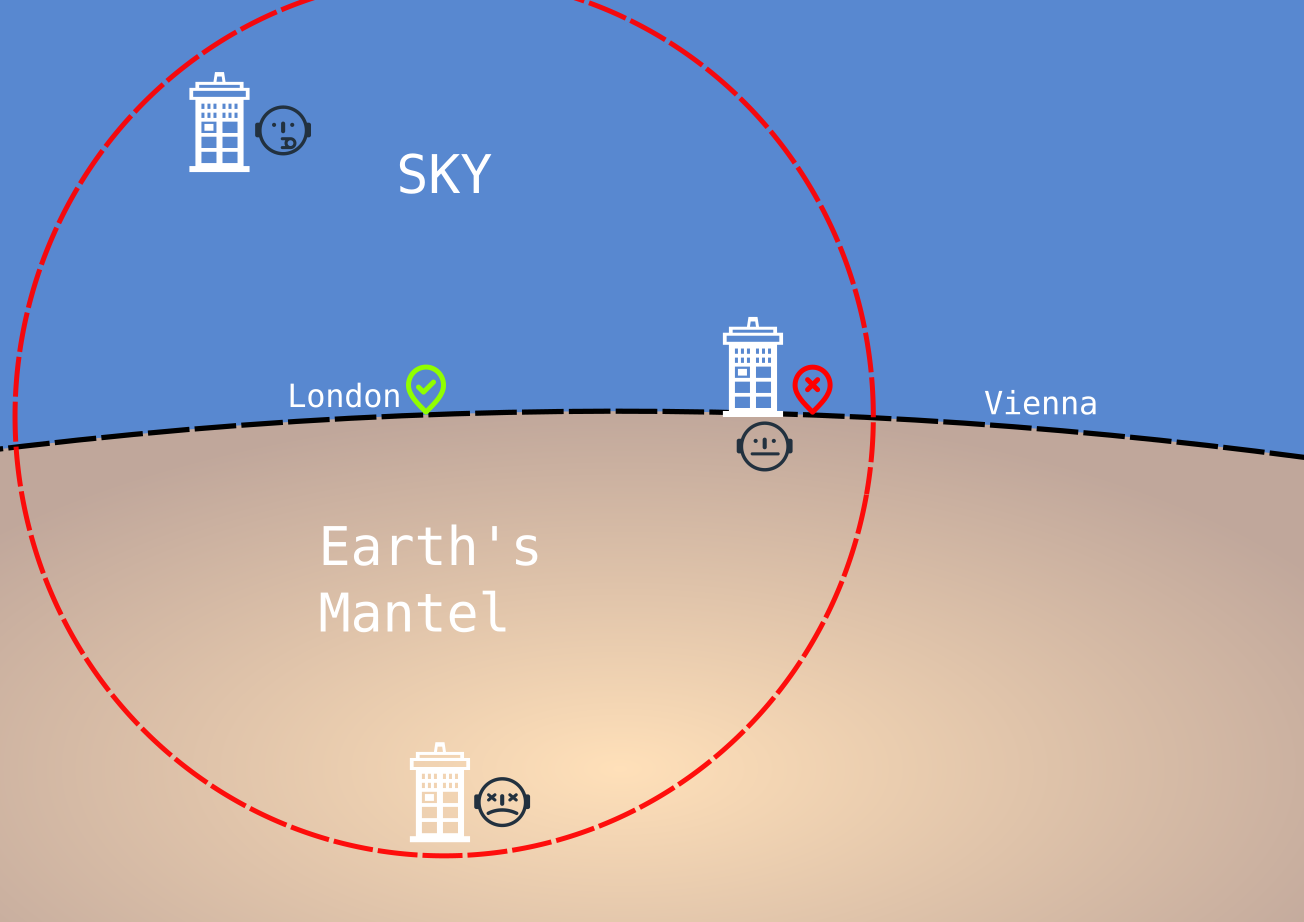
Miss by one microsecond and you’re already a metre adrift from Earth’s orbit alone. Miss by one second and that same orbital motion puts you 30 kilometres off — and that’s before the galactic and cosmic velocities add their unpredictable contribution. On a bad day, vectors aligned against you, that second of error could place you closer to Vienna than to London. And crucially, that displacement isn’t on a map — it’s in three-dimensional space. The error vector points in any direction: above you, beside you, or straight down through the crust.
Vienna is a survivable outcome. The mantle is not.
This is, ultimately, why the traveller cannot simply aim for the surface. The margin of error on the time coordinate makes a direct landing statistically indistinguishable from Russian roulette. You materialise in a safe volume of space, check your instruments, and then navigate to Earth. The spacecraft isn’t a luxury. It’s the error budget.
The Engineering Approach
So what would successful time travel actually look like?9
The honest answer is: it would look less like a phone box and more like a space mission.
A time traveller targeting Earth’s past wouldn’t aim for Earth’s current coordinates. They would need to solve a cosmological navigation problem first — calculating where in space Earth was at the target moment. This requires knowing:
- Earth’s position in its orbit around the Sun at the target moment
- The Sun’s position in its galactic orbit at the target moment
- The Milky Way’s position relative to the local group at the target moment
- And so on, recursively, up whatever reference frame ladder you care to climb
Armed with that calculation, the sensible approach would be to materialise somewhere in space at the correct moment in time — far from anything solid — then navigate through space conventionally to intercept Earth as it passes through.
In other words: a time traveller visiting Earth’s past would arrive in a spacecraft, compute an intercept trajectory, and catch the planet mid-orbit. Like a rendezvous manoeuvre, but with more existential weight.
It Gets Worse (Of Course It Does)
You might think: fine, if we have the technology to travel through time, surely we can calculate the coordinates precisely enough to land safely.
And you’d be right to try. But here’s the deeper problem: every set of coordinates is relative to a chosen reference frame — and whichever frame you pick, that choice is now baked into your machine. Pick the Sun as your anchor and the machine targets positions relative to the Sun. Pick the galactic centre and you get a different set of coordinates entirely. Neither is wrong. Neither is absolute.
What this means in practice: the machine doesn’t just need a clock. It needs a cosmological worldview — a complete encoding of what frame it’s navigating in, and where everything in that frame was at every moment in history. You can get arbitrarily precise within your chosen frame. But the frame itself is a design decision, and every design decision has consequences.
Which is exactly what leads us to the most interesting question.
A Fair Objection
Someone will point out that you could simply define Earth as your reference frame — if Earth is always the origin, it’s always at (0,0,0) by definition, and the spatial problem dissolves. This is the relativistic worldline argument10: a machine that follows Earth’s causal history backward always finds the planet.
The problem is circular. To build a machine that follows Earth’s worldline, you need to encode its complete trajectory through space-time — which requires knowing where Earth was relative to everything else. You haven’t eliminated the calculation. You’ve hidden it inside the navigation computer. The precision requirement is identical.
More importantly, it forces a design choice that fiction never acknowledges. Is your machine a follower — coupled to Earth’s worldline, riding its history like a train on rails, never losing the planet — or a jumper — targeting a fixed point in space-time, landing wherever the maths puts you? The TARDIS is a jumper. That’s why the Doctor would be in space. A follower machine would work, but it carries a stranger implication: it can only go as far back as Earth exists.
Why This Is Actually More Interesting
Strip away the phone box and what you’re left with is a richer story.
A time traveller visiting the distant past isn’t stepping out onto a familiar street. They’re a lone craft decelerating into an unfamiliar sky, matching velocity with a planet that has no idea they’re coming, threading an approach corridor between the Moon and the upper atmosphere. They have period-accurate star charts and a lot of anxiety. They are, in every meaningful sense, an astronaut who also happens to be a historian.
The time travel story worth telling doesn’t begin in a car park. It begins in darkness, somewhere in the inner solar system, with a navigation lock on a blue-green planet that doesn’t know it’s being hunted. The hard part isn’t the physics of the jump. It’s everything that comes after.
And one question no story has thought to ask: if your machine follows Earth’s worldline — coupled to the planet through every moment of its history — what happens when you push it far enough back that the Earth hasn’t formed yet?
References
-
Doctor Who, BBC Television (1963–present). The TARDIS — Time And Relative Dimension In Space — is perhaps the most famous stationary time machine in fiction. ↩︎
-
Back to the Future, dir. Robert Zemeckis, written by Robert Zemeckis and Bob Gale (Universal Pictures, 1985). ↩︎
-
H.G. Wells, The Time Machine (1895). Full text via Project Gutenberg. ↩︎
-
“How Fast Is Earth Moving?”, Space.com. Earth’s orbital speed is approximately 30 km/s (67,100 mph). ↩︎
-
“Orbital Period of the Sun in the Milky Way Galaxy”, NRAO Ask an Astronomer. The Sun orbits the galactic centre at approximately 230 km/s, completing one orbit roughly every 226 million years. ↩︎
-
“Cosmic Microwave Background”, Wikipedia. The Local Group moves at approximately 620 ± 15 km/s relative to the CMB rest frame. ↩︎
-
Caleb A. Scharf, “The Utter Failure of Fictional Time Travel”, Scientific American, August 2018. ↩︎
-
“GPS Accuracy”, GPS.gov (U.S. Government). GPS atomic clocks maintain nanosecond-level synchronisation. ↩︎
-
This thought experiment treats time travel as a coordinate-targeting problem — a machine that jumps to a chosen point in space-time. Under General Relativity, actual travel to the past would require closed timelike curves, which carry their own constraints and paradoxes. That’s a separate (and considerably thornier) problem, left for another post. ↩︎
-
“This Is Why a Time Traveler Would NOT Appear in Space”, AuthorCarlAra.com. A counter-argument grounded in relativistic worldlines — worth reading for the opposing view. ↩︎